What Happens at a Fed Policy Meeting and Why Traders Care


Federal Reserve announcements are among the most closely watched events in global markets. Within minutes of a policy release, currencies can jump, gold can go up or down, equity indices can lurch higher or lower, and bond yields can shift sharply. It is rarely just the headline interest rate decision that moves prices. What really matters is what the Fed signals about inflation, growth and the policy path ahead.
At the Fed’s meeting on 28 January 2026, for instance, officials held the federal funds rate at 3.50-3.75% exactly as markets expected. Even so, traders listened closely to Chair Powell’s wording. A subtle shift in tone can often matter more than the rate decision itself.
What the FOMC Actually Is
The Federal Open Market Committee (FOMC) is the Federal Reserve’s policy setting group. It consists of the seven members of the Board of Governors, the president of the New York Fed, and four other regional Fed presidents who rotate as voting members. All 12 regional presidents attend meetings and contribute to discussion, even if they are not voting that year.
The FOMC meets eight times a year to review economic data on growth, employment and inflation. Its mandate, maximum employment and stable prices, guides its decisions on the federal funds rate. Because this rate influences borrowing costs across the entire US economy, its impact spreads quickly to global markets through bond yields, the US dollar and broader financial conditions.
Inside a Fed Policy Meeting
A typical meeting produces three core outputs:
1. The interest rate decision
Will the committee raise, cut or hold rates? Traders track this closely, but the market reaction often depends on whether the result matches expectations. A well telegraphed move may cause little reaction, whereas a small surprise can trigger sharp swings.
2. The policy statement
Issued immediately after the decision, the statement summarises the Fed’s view on inflation, employment and economic risks. Traders compare each line with the previous version. Even a single adjective such as “persistent,” “moderating,” or “elevated” can shift expectations for future policy.
3. Clues about inflation and growth
Every decision reflects how the committee sees the balance of risks. Markets try to infer whether the Fed is leaning more concerned about inflation or more confident about growth, as this shapes the probable rate path.
Why the Fed Chair’s Press Conference Matters
After the statement, the Fed Chair holds a press conference to explain the decision and take questions. Traders analyse this closely because it often contains additional nuance. This is where “forward guidance” comes in, the Fed’s way of signalling how policy might evolve without making firm commitments. Phrases about monitoring risks, being “data dependent” or proceeding “meeting by meeting” can tell markets whether rate cuts or hikes are more likely over the coming months.
Why Markets Move Even When the Fed Does Nothing
Sometimes the Fed keeps rates unchanged and markets still move sharply. That is because investors price in expectations long before the announcement. If the Fed’s tone differs from those expectations, whether more cautious, more confident or more concerned about inflation, markets adjust rapidly. In many cases, traders react more to the outlook than the decision itself.
Market Volatility Around FOMC Releases (Gold, 5-Minute Chart)
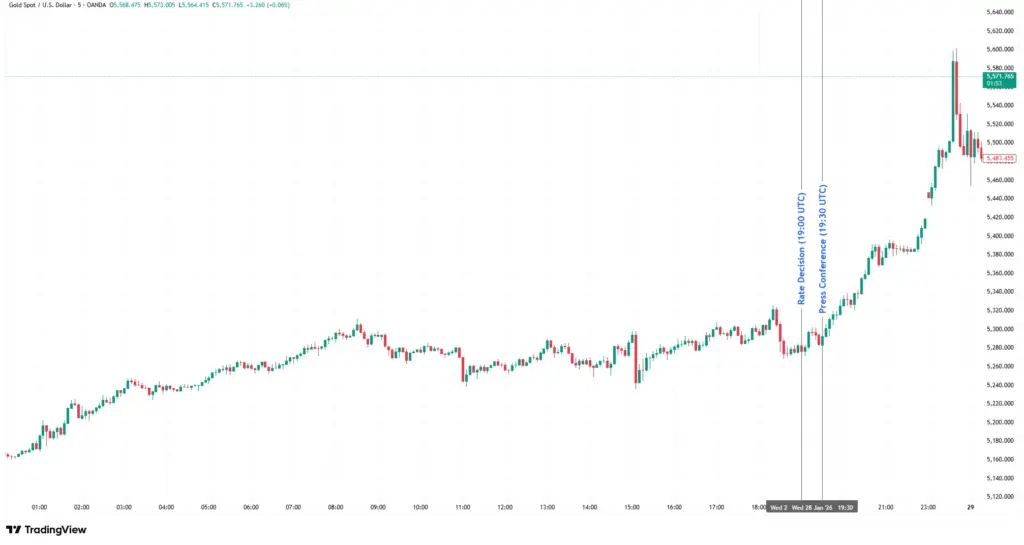
Source: TradingView. Gold spot price (XAU/USD), 5-minute chart. Past performance is not a reliable indicator of future performance. Data as of 29 January 2026.
Vertical markers highlight the rate decision (19:00 UTC) and the start of Chair Powell’s press conference (19:30 UTC), where markets often see a second wave of volatility.
Market volatility often increases in waves around FOMC announcements, with a second reaction phase commonly occurring during the Chair’s press conference.
Why Traders Across Asset Classes Care
Fed policy affects every corner of the market:
- US dollar: Rate expectations drive capital flows, making the dollar highly sensitive to Fed guidance.
- Gold: Moves with changes in real yields; lower real rates often support gold prices.
- Equities: Sensitive to financial conditions, liquidity and discount rates.
- Bonds: Directly linked to the expected path of interest rates.
Bottom Line
Fed meetings matter because they shape expectations, liquidity and global risk appetite, not just because of the rate decision on the day. The tone, guidance and outlook often prove more important than the headline number.