Forex Market Structure: How it Works
The forex market, also known as the foreign exchange market, is the largest and most liquid market in the world, with over $6 trillion circulating per day in trading volume. But how is this enormous marketplace structured? In this article, we will look into the forex market structure, we’ll explain the crucial role of the interbank foreign exchange market and we will also break down what a forex order is, the different types of forex orders and how they interact within this key player ecosystem. Let’s get straight into it!

What does 'Market Structure' mean in Forex?
When traders talk about 'market structure' in forex, they are trying to map out how orders move through the system, who trades with whom and where the liquidity is actually comes from. Unlike the stock market, which usually runs through centralised exchanges such as the NYSE, the foreign exchange (forex) market has no single hub. There is no main exchange, no trading floor, no single building where all the action takes place. Instead, forex is an over-the-counter (OTC) market. Transactions happen directly between participants via electronic communication networks, bank dealing systems and trading platforms. Think of it as a global web of connected counterparties rather than one central marketplace.
Let's dive deeper into this "global web".
What is the Forex Market Structure?
At the top of this web sits the interbank foreign exchange market. This is the domain of major commercial banks, investment banks, central banks and large financial institutions that regularly exchange very large volumes of currency with one another. The prices agreed in the interbank foreign exchange market effectively become the primary benchmark for the rest of the forex market. Everyone further down the chain is, in one way or another, referencing what happens here.
Below that is a layer made up of liquidity providers and prime brokers. In other words, these are large banks and non-bank financial institutions that continuously stream bid and ask quotes in different currency pairs to brokers and institutional clients. By consistently showing tradable prices as well as being willing to transact at those prices, they inject liquidity into the system which makes it possible for others participants in the forex market to execute trades quickly and at competitive levels.
The next level down are the forex brokers. Their role is to essentially bridge the gap between the wholesale market and the end user. Most retail traders and many professional traders cannot access the interbank foreign exchange market directly. Instead, they place trades through a broker’s platform. The broker typically aggregates price feeds from several liquidity providers, displays these quotes to clients and then routes client orders into the broader market according to its execution model.
Major participants located across global financial centres such as London, New York, Tokyo, Singapore and Sydney are linked by electronic trading infrastructure enabling the forex market to function almost continuously from Monday to Friday. That means as one region’s trading day winds down, another’s begins. This creates overlapping trading sessions and keeps pricing and trading activity going in most major currency pairs throughout the 24-hour cycle.
Forex Order Types | Understanding Forex Orders
A forex order is an instruction to buy or sell in the market. Traders use different types of forex orders to establish a position or manage the trading risk. It’s crucial to understand the different order types especially if you are new to forex trading.
Market Orders
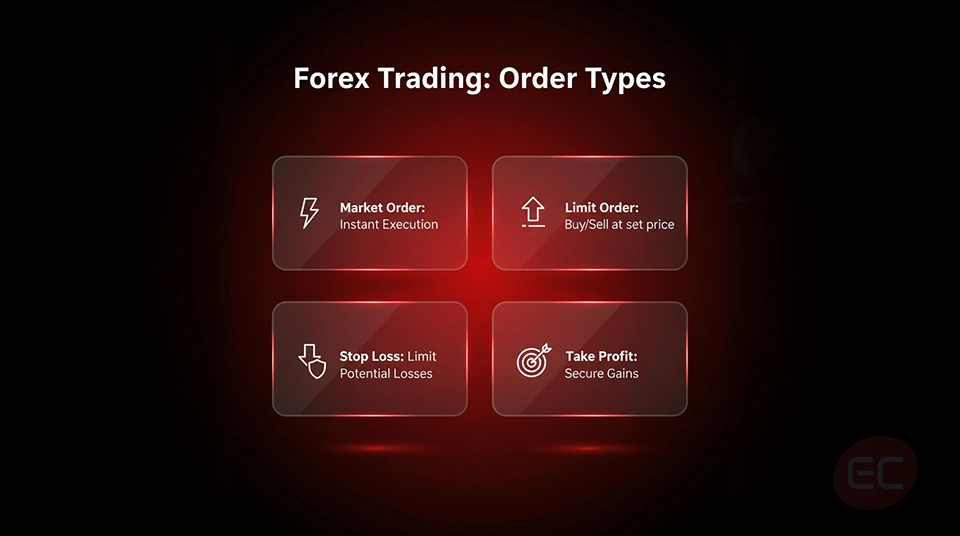
A Market Order is the easiest forex order you can make. By placing a market order, you are telling your broker that you want to buy or sell a particular currency pair right now at whatever price the market is currently offering. It's like grabbing something off a shelf at the store and heading straight to checkout. No fuss, no back-and-forth. However, despite it being super simple, it is important that you know when to use it because once you press send, the order fills instantly. Can’t change a thing after. The execution price is locked in.
Limit Orders
There are two types of Limit Orders:
Buy Limit Orders are used when you think the price will dip before it moves higher. For example, if the current price of EUR/USD is 1.2000 and you expect it to drop to 1.1950 before rebounding, then you'd place a buy limit order at 1.1950.
Sell Limit Orders are used when you think price will rise before it resumes its downward momentum. Using our EUR/USD example, if the current price is 1.2000 and you expect price to move up towards 1.2050 before it resumes its downtrend, you'd place a sell limit order at 1.2050. A limit order can also be used as a Take Profit Order. Let’s say you already opened a EUR/USD long position at 1.2000. You would like to close the position if the price advances to 1.2100. Then, you can just simply place a limit order at 1.2100 to cover your position.
Stop Loss Orders
Stop Loss Orders can be used to open a position or manage your risk of an existing order.
A Stop Buy Entry Order can be placed to enter a long position only if and when the price breaks above a certain price level. For example, if the current price of EUR/USD is 1.2000 and you think the price will accelerate upwards to break 1.2050, then you'd place a buy stop order at 1.2050.
On the other hand, a Sell Stop Entry Order can be placed to enter a short position only if and when the price drops below a certain price level. Using our EUR/USD example, if you think the price may be a free fall mode once it breaks below 1.1950, then you'd place a sell stop order at 1.1950.
Another key role of the stop loss order is to protect your trading capital. If the market goes against your position, you can use a stop loss order to automatically cover your position at a predetermined price level. For example, if you've opened a long position of EUR/USD at 1.2000 and wish to close the position should the price fall to 1.1950, then you can set a stop loss order at 1.1950.
How Orders are Processed | Forex Market Structure
If you have made it this far, then you have understood different types of forex orders. But once you place an order, you may wonder how exactly your order processed in the forex network.
Let’s break it down:
- Retail traders, like you and I, place buy or sell orders via trading platforms.
- Forex brokers then take those orders, aggregate them and then pass them onto the liquidity providers.
- Liquidity providers, such as banks, hedge funds, step in to execute the orders.
- At times, liquidity providers may need to pass high-volume forex orders over to the interbank foreign exchange market, the is the highest level of the forex market structure.
A key point to understand is that forex orders are the smaller pieces that make up a huge and interconnected structure known as the forex market. Once you have an understanding of where your orders fits in when you place them, you will start to wonder why slippage happens, why spread varies and why you might sometimes experience slight delays with order execution. These are some of the deeper issues beginner traders might struggle with.
What Factors Drive Forex Prices?
The forex market structure is dynamic and it is influenced by a number of economic and political factors. These play a significant role on how prices fluctuate and how orders move. Some key factors include:
- Central Bank Policies: Interest rate changes can rapidly shift currency demand.
- Economic Indicators: Inflation rates, GDP growth rates and employment figures are some key data figures that can influence trading sentiment.
- Political Factors: Trade wars, elections and geopolitical conflict can create a shift in currency strength.
- Market Sentiment: Worldwide news and even trading psychology can have a major influence on how buyers and sellers enter the market.
Forex Market Structure FAQ
What is the Forex Market Structure?
It is how the global currency market is organised, from large banks in the interbank foreign exchange market all the way down to the individual retail trader.
How do Forex Orders flow through the market?
Forex orders are placed by the retail traders and passed to the brokers. From there, the brokers pass orders onto liquidity providers or the interbank foreign exchange market. This structure is designed to ensure that forex orders reach the relevant counterparty, maintaining liquidity and price stability in the market.
Who are the Key Players in the Forex Market Structure?
The key players include central banks, commercial banks, hedge funds, brokers and retail traders. The forex market structure is a hierarchy, with the interbank foreign exchange market sitting at the very top, followed by the institutional then the retail layers.
Is the Forex Market decentralised?
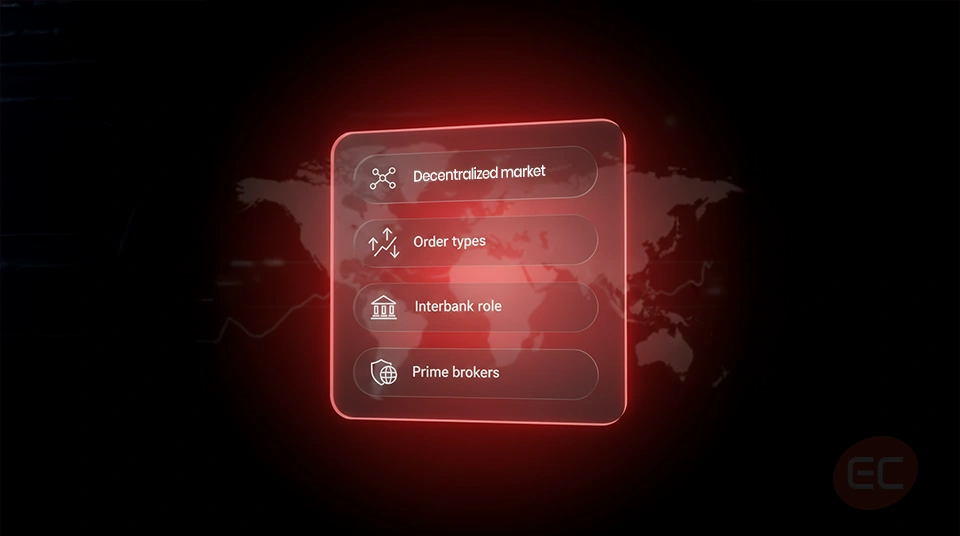
Yes. Unlike the stock market, there is no direct central exchange in the forex industry. The way foreign exchange works is by over-the-counter transactions through a wide range of banks and brokers, making the forex market structure decentralised by nature.
Forex Market Structure Summed Up
For some it may be daunting when learning about the forex market structure at first glance, but it is important for traders to understand this system and how each layer is interconnected, from the interbank foreign exchange market down to the very trading platform you use as a retail trader. The forex market doesn't move at random, there is an underlying logic behind how forex orders are processed and how market prices move on a daily basis.
Congratulations for making it this far into our course! If you found this article useful and you would like to deepen your trading knowledge, then keep on reading the EC Academy as we explore more topics that will take you from a beginner to an expert trader in no time!